Oxford Circus London 2026: Tube Lines, Exits, Shops and the Traffic Free Street
Oxford Circus is where Oxford Street meets Regent Street. Here is how the station works, what changed when the street went traffic free, and what to see nearby.
In this guide
- Oxford Circus at a glance
- What is Oxford Circus?
- Why is it called Oxford Circus?
- The traffic free Oxford Street and what it means at the Circus
- Oxford Circus station: lines, exits and tips
- Is Oxford Circus busy today?
- What shops are around Oxford Circus?
- Things to do near Oxford Circus
- What is the best part of Oxford Street?
- Is Oxford Street close to Harrods?
- Where to eat near Oxford Circus
- Oxford Circus at Christmas
- Oxford Circus or Piccadilly Circus?
- Tips for visiting Oxford Circus
- Visit TALES House, two minutes from Oxford Circus
- Frequently asked questions
- Plan the rest of your trip
Oxford Circus is the famous crossroads where Oxford Street meets Regent Street, right in the heart of London’s West End. Above ground it is the busiest shopping junction in the city, ringed by four curved stone buildings full of flagship stores. Below ground it is Oxford Circus station, served by the Bakerloo, Central and Victoria lines. This guide explains everything a visitor needs to know: what changed when Oxford Street went traffic free in October 2026, how to use the station and avoid the crowds, why it is called a circus, the best shops and sights within a few minutes’ walk, and a calm, free stop just two minutes away at TALES House on Cavendish Square.
Oxford Circus at a glance
| What | Details |
|---|---|
| What it is | The junction of Oxford Street and Regent Street in the West End |
| Tube lines | Bakerloo, Central and Victoria |
| Opened | November 1819, designed by John Nash |
| Traffic | Oxford Street either side is traffic free since 26 October 2026; Regent Street traffic still crosses |
| Nearby streets | Regent Street, Carnaby Street, Great Marlborough Street, Cavendish Square |
| Big sights within 10 minutes | Liberty, Hamleys, Carnaby, the London Palladium, BBC Broadcasting House |
| Free stop nearby | TALES House, 28 Cavendish Square, two minutes’ walk, open daily 11am to 8pm |
| Busiest times | Saturday afternoons and December evenings |
What is Oxford Circus?
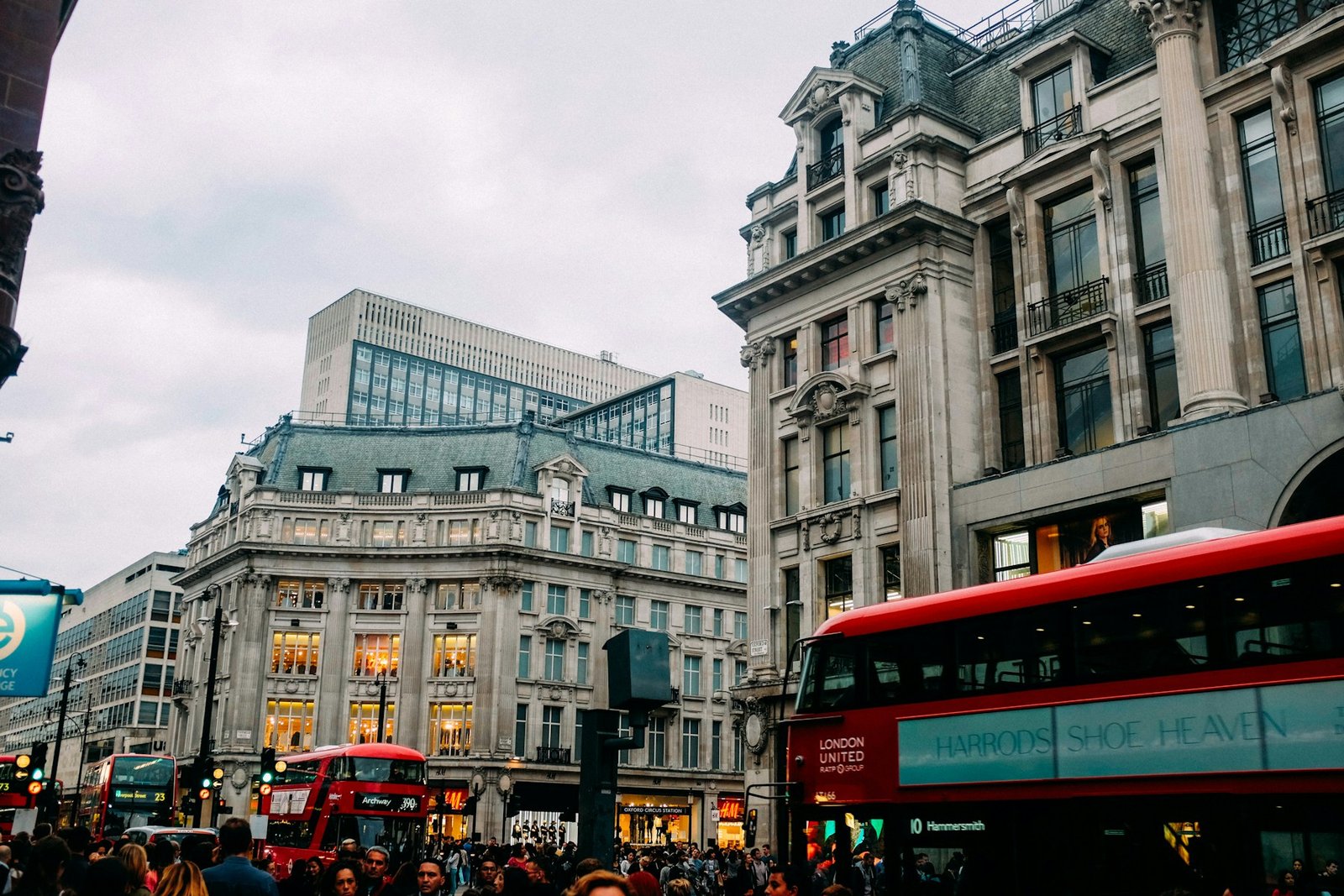
Oxford Circus is a road junction, not a single building or attraction. It is the point where Oxford Street, running east to west, crosses Regent Street, running north to south. The four corners are formed by matching curved buildings in pale Portland stone, which give the junction its round shape. These buildings have been Grade II listed since 1973 and are home to big flagship stores.
Underneath the junction is Oxford Circus Underground station, one of the busiest on the London Tube network, with entrances on all four corners. For most visitors, Oxford Circus is the natural starting point for a day of shopping: walk west along Oxford Street towards Selfridges, east towards Tottenham Court Road, or south down Regent Street towards Piccadilly Circus.
Why is it called Oxford Circus?
In London, a circus is not a place for clowns and acrobats. The word comes from the Latin for circle, and in Georgian town planning it meant a round open space where several streets meet. Bath has its famous Circus, and London has both Oxford Circus and Piccadilly Circus.
Oxford Circus was designed by the architect John Nash as part of his grand new Regent Street, built to link the Prince Regent’s home in St James’s with Regent’s Park. Building began in 1816 and the circus officially opened in November 1819. It was first called Regent Circus North, while Piccadilly Circus at the other end of Regent Street was Regent Circus South. Over the nineteenth century the name Oxford Circus took over, and it stuck for good when the Tube station opened in 1900.
Nash’s original buildings were replaced in the early twentieth century by the curved stone blocks you see today, but the circular layout he planned has stayed the same.
The traffic free Oxford Street and what it means at the Circus
On Monday 26 October 2026, Oxford Street between Orchard Street, by Selfridges, and Great Portland Street, just east of Oxford Circus, became permanently closed to traffic. That stretch of almost 1km takes in the Circus itself, so for the first time you can walk along Oxford Street on either side of the junction without buses and taxis rushing past.
There is one important detail for anyone standing at the Circus: Regent Street is still open to traffic. Buses, taxis and cars on Regent Street continue to cross Oxford Street at Oxford Circus, so the traffic lights at the junction still matter. Wait for the green man before crossing Regent Street.
Other changes to know about:
- Bus stops have moved. Buses that used to run along Oxford Street now use nearby streets, with new stops on Wigmore Street, Henrietta Place and Cavendish Place, north of the Circus. Henrietta Place and Cavendish Place both run alongside Cavendish Square, a short walk from TALES House.
- No cycling on the traffic free section. Bikes, electric bikes, electric scooters and pedicabs are not allowed, though mobility scooters are welcome.
- More space to stop. You can now stand in the middle of Oxford Street to take photos of the Circus and the lights.
For more on the change, and everything else on the street, read our full Oxford Street guide.
The famous diagonal crossing
Before pedestrianisation, Oxford Circus was best known for its X shaped crossing. Opened on 2 November 2009 and inspired by the Shibuya crossing in Tokyo, it stopped all traffic at once so that people could walk straight across the junction diagonally. It was a big improvement on the old barriers and narrow pavements, and it became one of the most photographed crossings in London. With Oxford Street now free of traffic on both sides, the junction is calmer still.
Oxford Circus station: lines, exits and tips
Oxford Circus station is served by three Tube lines:
- Central line (red), which runs east to west along the whole of Oxford Street, stopping at Marble Arch, Bond Street, Oxford Circus and Tottenham Court Road.
- Victoria line (light blue), for fast trips to Victoria, Green Park, Warren Street, King’s Cross St Pancras and Brixton.
- Bakerloo line (brown), for Piccadilly Circus, Charing Cross, Waterloo, Regent’s Park and Baker Street.
The station first opened in 1900 on the Central London Railway, now the Central line. The Bakerloo line arrived in 1906 and the Victoria line in 1969.
What tube line is Oxford Street?
The Central line is the Oxford Street line. It runs directly underneath the street and has four stations along it: Marble Arch, Bond Street, Oxford Circus and Tottenham Court Road. Bond Street and Tottenham Court Road are also on the Elizabeth line, which is the fastest way to reach Oxford Street from Heathrow, Paddington, Liverpool Street and Canary Wharf. Bond Street is on the Jubilee line too, and Tottenham Court Road is on the Northern line.
Tips for using Oxford Circus station
- Expect crowds. On busy afternoons and in December, staff sometimes close the entrances for a few minutes to control numbers. If that happens, walk to Bond Street (about 8 minutes west), Tottenham Court Road (about 10 minutes east) or Piccadilly Circus (about 10 minutes south down Regent Street).
- Step free access. Oxford Circus does not have step free access from street to platform. If you need it, use Bond Street or Tottenham Court Road instead, and check the Transport for London website for lift updates before you travel.
- Use contactless. Tap in and out with a contactless card or phone. You don’t need to buy a paper ticket.
- Choose your exit. The four corner entrances are close together, but picking the right one saves crossing the junction. For John Lewis, Cavendish Square and TALES House, take the north west corner exit, by Oxford Street heading towards Bond Street.
Is Oxford Circus busy today?
Oxford Circus is busy almost every day, but some times are far busier than others. Saturday afternoons, school holidays and the weeks before Christmas are the peak, with December evenings under the Christmas lights the most crowded of all. Weekday mornings, especially before 11am, are the quietest.
For live information, check the Transport for London status updates or the TfL Go app before you set off. They show if the station is closed for crowd control or if any line is delayed. If the Circus is packed, step a minute away to the side streets: Cavendish Square to the north, or Great Marlborough Street and Carnaby to the south east, are noticeably calmer.
What shops are around Oxford Circus?
The area around Oxford Circus has some of the biggest and best stocked stores in the country. Here are the highlights within about five minutes’ walk.
| Shop | What it is | From Oxford Circus |
|---|---|---|
| Nike | Large flagship for trainers and sportswear | At the junction |
| IKEA | City centre store for homeware and small furniture | Just east on Oxford Street |
| TALES House | Independent African brands, gifts and a Christmas market, free to enter | 2 minutes north west, on Cavendish Square |
| John Lewis | Department store, with Oxford Street’s first Christmas tree outside | 2 minutes west |
| Liberty | Historic Tudor style department store for gifts and fabrics | 4 minutes south east |
| Hamleys | London’s famous toy shop, over several floors | 5 minutes south on Regent Street |
| Carnaby Street | Pedestrian street of fashion and lifestyle shops | 4 minutes south east |
| Selfridges | Grand department store with a famous food hall | 12 minutes west |
Regent Street, running south from the Circus, has flagships for brands such as Apple and many big names in fashion, all in elegant curving terraces. For a fuller list, including the high street chains along Oxford Street, see our guide to Oxford Street, and for opening times, including the Christmas late nights, see Oxford Street opening hours.
Things to do near Oxford Circus
Oxford Circus is about more than shopping. Within ten minutes’ walk you will find:
- Regent Street with its sweeping Nash architecture and, in winter, the famous Regent Street Christmas angels.
- Carnaby Street, the home of 1960s Swinging London, with its themed Christmas lights and independent shops.
- Liberty, a black and white Tudor style building from the 1920s, worth a look inside even if you don’t buy anything.
- The London Palladium on Argyll Street, one of the West End’s most famous theatres, a minute from the Circus.
- Hanover Square, just south west of the Circus, where a Harry Potter themed Christmas tree stands this year.
- BBC Broadcasting House and All Souls Church, a short walk north up Regent Street to Langham Place.
- Cavendish Square, a quiet garden square two minutes away, and TALES House on its north side.
- Soho, for restaurants, bars and nightlife, starting a few minutes to the south east.
- Marylebone, to the north west, for a village feel, independent shops and cafes.
What is the best part of Oxford Street?
Most visitors find the best stretch is the one between Selfridges and Oxford Circus. It is now traffic free, so it is far more pleasant to walk, and it has the biggest stores: Selfridges, John Lewis and the flagships around the Circus. It also has the quiet escapes, from St Christopher’s Place near Bond Street to Cavendish Square behind John Lewis.
The eastern half towards Tottenham Court Road is busier and more mixed, with high street fashion, music and souvenir shops, and it leads on to Soho and the Outernet. If you only have an hour, start at Oxford Circus, walk west to Selfridges, and stop off at Cavendish Square on the way.
Is Oxford Street close to Harrods?
Not really. Harrods is in Knightsbridge, around 3km from Oxford Circus. The quickest way is by Tube: take the Victoria line from Oxford Circus one stop to Green Park, then the Piccadilly line two stops to Knightsbridge. Allow about 15 to 20 minutes. You can also walk from Marble Arch across Hyde Park in about half an hour.
Can I wear jeans to Harrods?
Yes. Harrods says it does not have a specific dress code for the store or its restaurants, though it keeps the right to refuse entry to anyone it does not think is suitably dressed. Ordinary jeans, trainers and casual clothes are fine. Large backpacks may need to be worn on your front or checked, so travel light if you plan to visit both Oxford Circus and Harrods on the same day.
Where to eat near Oxford Circus
The streets around the Circus are packed with places to eat. A few areas to head for:
- Carnaby and Kingly Court, a three storey courtyard of restaurants just behind Carnaby Street.
- Soho, for the widest choice in the West End, from noodle bars to classic French bistros.
- Marylebone, north west of the Circus, for brunch spots, bakeries and relaxed restaurants.
- St Christopher’s Place, opposite Bond Street station, for a hidden lane of terraces.
- Department store cafes at John Lewis, Liberty and Selfridges, handy with children.
In December, book ahead for evening meals, as tables fill fast.
Oxford Circus at Christmas
Christmas is the most magical and most crowded time to visit. From Oxford Circus you can see three famous displays without moving far:
- Oxford Street’s Harry Potter themed lights stretching east and west along the street. See our Oxford Street Christmas lights guide.
- The Regent Street angels looking south from the Circus, one of the most photographed views in London.
- Carnaby Street’s themed lights, a few minutes to the south east.
A two minute walk west brings you to Oxford Street’s first ever Christmas tree, a 30ft fir decorated by John Lewis on the corner of Old Cavendish Street, switched on on 19 November 2026. Just behind it, TALES House on Cavendish Square switched on its own Christmas lights on 22 November and runs a Christmas market until 23 December.
For a complete route taking in all of these, see our guide to London Christmas lights.
| Christmas sight near Oxford Circus | Walk from the Circus |
|---|---|
| Oxford Street lights | At the junction |
| Regent Street angels | At the junction, looking south |
| Oxford Street Christmas tree, by John Lewis | 2 minutes |
| TALES House lights and Christmas market | 2 minutes |
| Harry Potter tree, Hanover Square | 3 minutes |
| Carnaby Street lights | 4 minutes |
Oxford Circus or Piccadilly Circus?
Visitors often mix up the two circuses because they sit at either end of Regent Street, about 10 to 15 minutes apart on foot. Oxford Circus is all about shopping, with department stores and flagships in every direction. Piccadilly Circus is the place for the giant illuminated screens, the statue known as Eros, theatres and Leicester Square nightlife. The best plan is to walk between them down Regent Street, which has some of the finest shopping and, at Christmas, the famous angel lights all the way.
Tips for visiting Oxford Circus
- Go early. Weekday mornings are the calmest time for shopping.
- Use another station if needed. Bond Street, Tottenham Court Road and Piccadilly Circus are all within 10 minutes’ walk.
- Watch the traffic on Regent Street. Oxford Street is traffic free, but Regent Street is not.
- Keep valuables close. As in any very busy area, watch your bags and phone in the crowds.
- Plan a break. Cavendish Square gardens and TALES House are a two minute walk away and much quieter than the Circus.
- Visit after dark in winter to see the lights in every direction.
Visit TALES House, two minutes from Oxford Circus
TALES House is at 28 Cavendish Square, a two minute walk from Oxford Circus. Leave the station by the north west corner, walk west along Oxford Street past John Lewis and its new Christmas tree, then turn right up Holles Street into the square. TALES House is a shop and event space for independent African brands, with fashion, accessories, beauty, homeware and gifts you won’t find anywhere else around the Circus. It is open daily from 11am to 8pm, and this season it hosts a Christmas market until 23 December.
Entry is always free, so you can simply walk in. If you also book a free VIP pass, it arrives by email with a QR code: show it at the door and spin the prize wheel for a gift.


Frequently asked questions
What shops are in Oxford St, London?
Oxford Street has more than 90 flagship stores, including Selfridges, John Lewis, Marks and Spencer, Primark, Nike, Zara, H&M, Uniqlo, IKEA, Boots and HMV. Just off the street, TALES House on Cavendish Square sells independent African brands, and Liberty, Hamleys and Carnaby Street are a few minutes from Oxford Circus.
What tube line is Oxford Street?
The Central line runs along the whole of Oxford Street, with stations at Marble Arch, Bond Street, Oxford Circus and Tottenham Court Road. Oxford Circus is also on the Bakerloo and Victoria lines, and Bond Street and Tottenham Court Road are on the Elizabeth line.
Is Oxford Circus busy today?
Oxford Circus is busy most days, especially on Saturday afternoons and in December. Check the Transport for London status updates before you travel to see if the station is closed for crowd control. Weekday mornings are the quietest time to visit.
Is Oxford Street close to Harrods?
Harrods is in Knightsbridge, about 3km from Oxford Circus. Take the Victoria line to Green Park and the Piccadilly line to Knightsbridge, about 15 to 20 minutes in total.
What is the best part of Oxford Street?
The traffic free stretch between Selfridges and Oxford Circus, with its department stores, flagships, the new Christmas tree outside John Lewis and quiet side streets such as Cavendish Square.
Can I wear jeans to Harrods?
Yes. Harrods has no specific dress code, though it can refuse entry to anyone it considers unsuitably dressed. Jeans and casual clothes are fine.
Why is Oxford Circus called a circus?
Circus comes from the Latin for circle. In Georgian London it meant a round junction where streets meet. John Nash designed Oxford Circus with curved corners as part of Regent Street, and it opened in 1819.
Is Oxford Circus closed to traffic?
Oxford Street on both sides of the Circus has been traffic free since 26 October 2026. Regent Street is still open, so buses, taxis and cars continue to cross at the junction.
Is Oxford Circus station step free?
No. Oxford Circus does not have step free access from street to platform. Bond Street and Tottenham Court Road, both nearby, are better options if you need lifts.
How far is Oxford Circus from Piccadilly Circus?
About 1km, a 10 to 15 minute walk straight down Regent Street, or one stop on the Bakerloo line.
Plan the rest of your trip
- Oxford Street London 2026: the complete visitor guide
- Oxford Street opening hours 2026
- Oxford Street Christmas lights 2026
- Regent Street Christmas lights 2026
- Christmas in London 2026: 25 things to do
- The TALES House Christmas market
Walk in any day, as entry is always free, or book a free VIP pass to spin the prize wheel. We’ll see you at 28 Cavendish Square.
About TALES House
TALES House London is a shop and event space for independent African brands, free to visit, at 28 Cavendish Square, just off Oxford Street, established by Bellafricana. We write these guides to help visitors make the most of the West End. Details such as dates and times can change, so check official sources before you travel.